:info: This article uses native name orderings (e.g., Matoi Ryuko instead of the westernised Ryuko Matoi), and contains spoilers for Kill la Kill.
Christian Themes in Kill la Kill
Publication:
The religion of Christianity requires no introduction. It is among the most foundational faiths in written history, spanning each continent of Earth. Diverse among its various denominations, yet unified at its core: The belief in that there is a God, who through Jesus Christ, freed humanity of its sins, and opened the gates of Heaven to everyone. With grave oversimplification of centuries of history, its spread was with both conviction and by force.
With something so fundamental, it is bound to show up in various kinds of media, even when unexpected. Sailor Moon’s episodes feature priests, churches, and crosses. Sailor Moon already borrows a lot from western folklore, be it the tale of Endymion and Selene, or the various planet adjacent personalities of the Sailor Senshi. In contrast, Kill la Kill doesn’t seem all that inherently interested in western folklore, or religion. One moment stood out to me however. At the beginning of the final act, Kiryuin Satsuki (very much deservedly) crucifies her mother, Ragyo. This made me wonder, why did the creators pick that? Firstly it’d be foolish to rule out that her crucifixion could also have just been at the service of the rule of cool, but I believe there’s much more that could be found here.
Ragyo’s Crucifixion
I started looking around for a bit, until I encountered the word Haritsuke. This was a Japanese method of punishment which upon first sight seems much like the western-stlye Roman crucifixion but it diverges in its timeline, function, and purpose. First of all, the method of punishment is said to have originated in the 12th century. Japan was not exposed to Christianity until the 16th century, which makes simple adoption of the method rather unlikely. Furthermore, Haritsuke used ropes to restrain the condemned. Physical injury was delivered by weapons, not the method of punishment itself. Another distinction is worth making. Men and women would be crucified with differently shaped crosses. Men were tied to something shaped like the character キ. A bit like a modern electrical post. Women on the other hand would be tied to something more resembling a “traditional” cross. See the character 十.
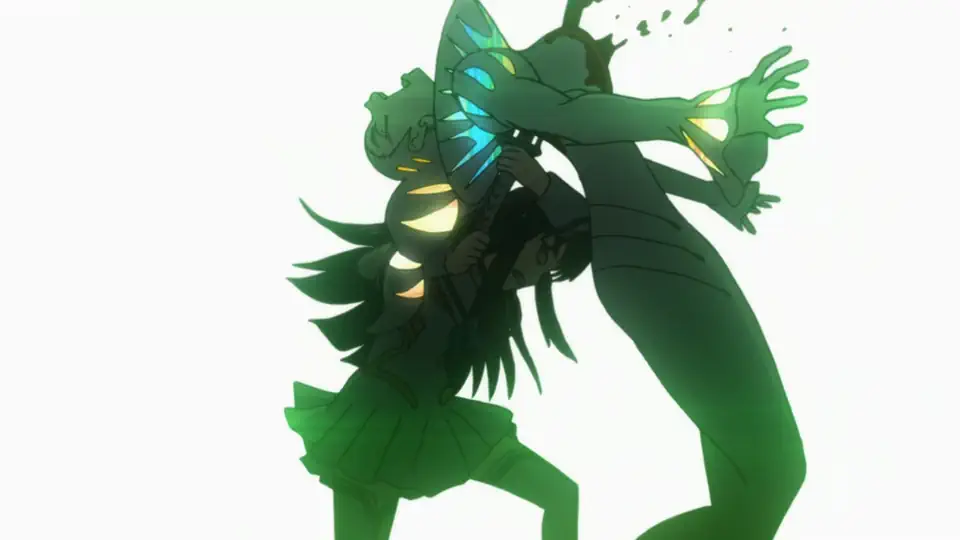
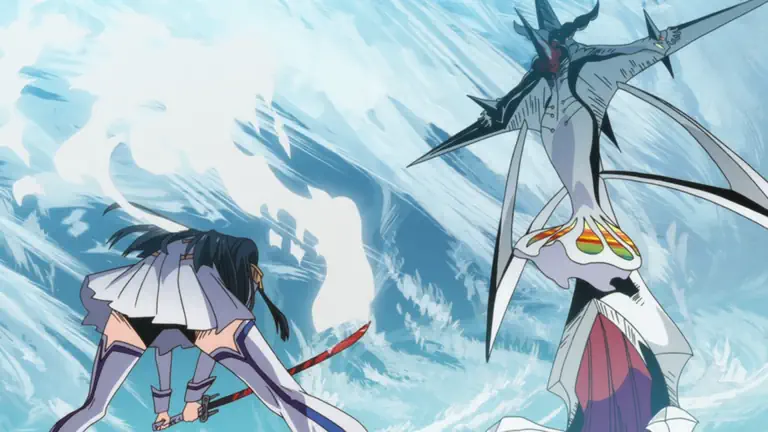
In episode 17, Satsuki stabs Ragyo in the back, and uses bakuzan to throw her onto a physical rendition of the Honnouji Academy emblem. The structure pierces Ragyo through her hands, and through her chest, where Satsuki stabbed her. Satsuki declares her true intention. Honnouji Academy was set-up, with the purpose of ending Ragyo’s reign. The exchange continues in the next episode. Ragyo asks, “Really now, you’d call your own mother a monster?” to which Satsuki replies “After being stabbed through the heart, you remain unphased. What else could you be?” Ragyo declares herself to be the “ultimate lifeform”. Satsuki explains how her father revealed Ragyo’s secrets to her.
The time for speeches is over!
People do not live for the sake of clothing!
Ragyo’s crucifixion, I believe to be a blend of the two different forms. The stab through the chest stems from Haritsuke, while being impaled by her arms is more reminiscent of The Passion. While a strange parallel between Jesus Christ and Kiryuin Ragyo emerges, it is quickly apparent that this is the inverse. She declares herself to be the “ultimate lifeform”. But as Satsuki notes, she is unphased by being stabbed through the heart. Jesus Christ’s suffering on the cross is significant, because Jesus’s Passion on the cross, and even Christ as a whole is a deity who humbled himself, and became obedient to death. Jesus sacrifices himself to free humanity of its sins. He chose to make himself nothing, taking the nature of a servant. Ragyo does the opposite. She clings to power, and she denies the suffering. She refuses to die, on multiple occasions surviving conditions usually not compatible with life. Her vanity and hubris do not let her die, until she no longer sees any reason to continue. Ryuko would even bring her back to Earth, but Ragyo ends herself.
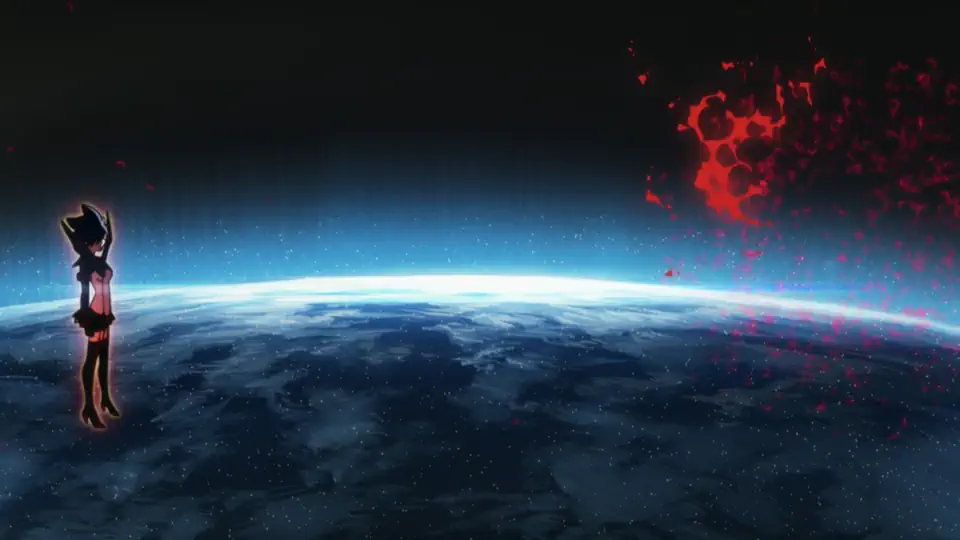
Ragyo likes to mention the concept of the original sin, but her interpretation differs from Christianity's. To her, clothing is the original sin. In the world of Kill la Kill, Life-Fiber infused clothing is attributed the acceleration of human evolution. The faith puts clothing as a consequence of the original sin, as Adam and Eve realized their exposure, not the inciting fact. Ragyo also talks a lot about “the nature of the universe” and the “cosmos”. This could be her just using faux intellectuality to seem higher than she is, just like she does with her power. Ragyo is clearly not Christian, but like how the religion permeated most of the world, it likely wasn’t unknown to her either.
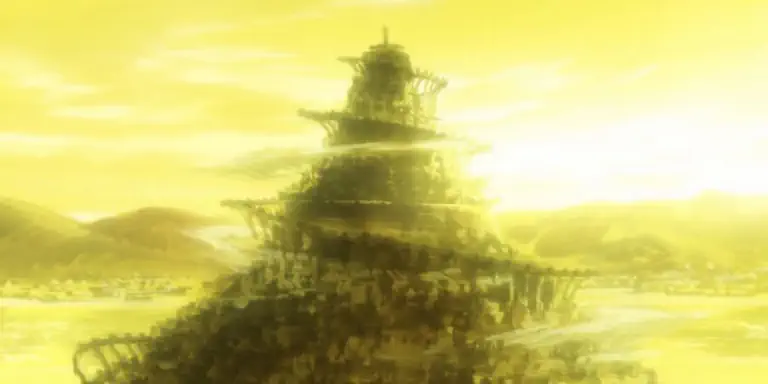
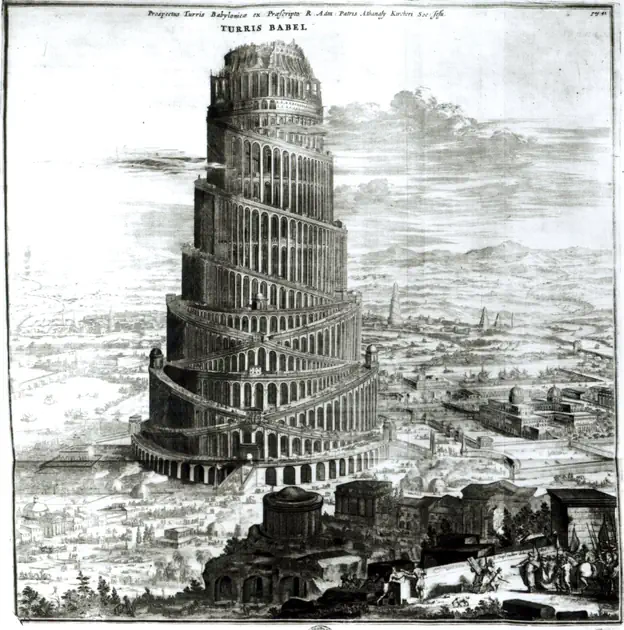
The Tower of Babel also comes to mind. It was a Biblical story about humanity uniting in defiance of God by constructing a tower to reach the Heavens. Humanity is struck with different languages as a punishment. Honnouji Academy is the tower of Babel that succeeds, Ragyo is not a deity; She cannot uphold the power of God, nor his grace and kindness.